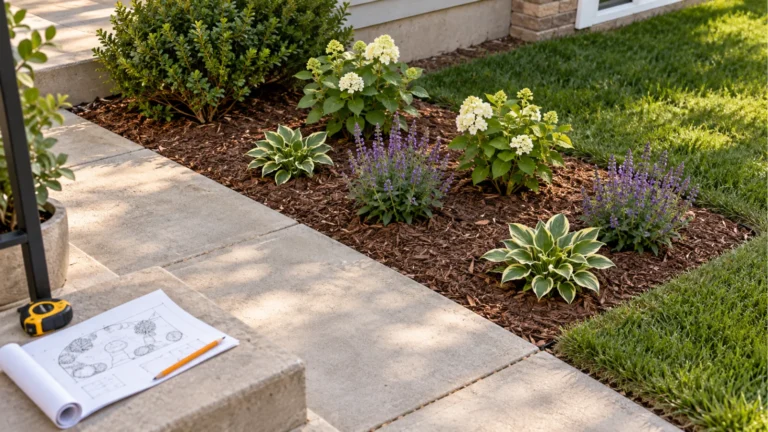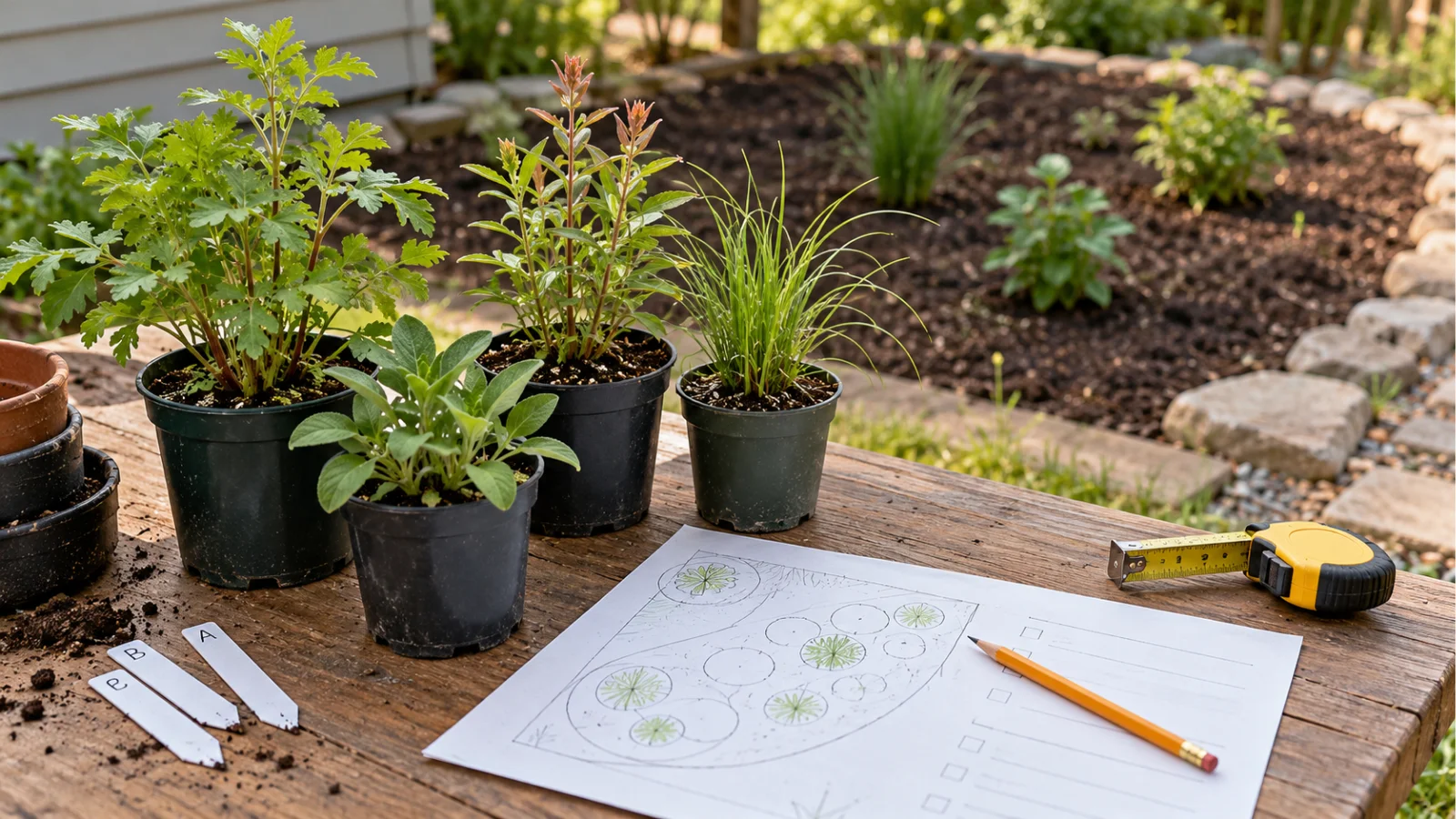
To start a native plant garden, identify plants native to your region, record the conditions in your chosen bed, and match each plant to the available light, soil, moisture, and space. Then draw the mature plant footprints and prepare a manageable first section before buying.
The word “native” needs a location. A plant native to part of North America may be outside its natural range in your state, province, or local ecological region. A national plant list is a starting point, not a complete shopping list.
Begin with one bed you can prepare and care for. A small, suitable planting can teach you more about the site than a large purchase made before checking the conditions.
1. Establish what “native” means for your garden
Look for information tied to your state, province, county, or ecological region. Use scientific names to distinguish plants that share similar common names.
Check the species’ documented range and habitat rather than relying only on a nursery sign saying “native.” Ask a knowledgeable supplier whether the plant is regionally native and suitable for your site.
The Canadian Wildlife Federation emphasizes choosing regionally native plants because they provide food and shelter for local wildlife. It also explains that native plants can suit a range of garden styles, not only meadow-like designs. cwf-fcf.org
Use regional resources as filters
| Resource | How it helps | What to verify next |
|---|---|---|
| Local extension service or native plant society | Regional advice and species information | Your particular site conditions |
| Xerces regional plant lists | Pollinator-oriented choices | Range, light, soil, and mature size |
| Canadian Wildlife Federation resources | Canadian native-plant information | Local suitability and current species details |
| A knowledgeable native nursery | Availability and growing guidance | Botanical identity and plant source |
Xerces’ regional plant lists offer a place to start. Canadian readers can also explore the Canadian Wildlife Federation’s native-plant guidance. Xerces Society
A published regional example should help you make decisions, not persuade you to copy plants unsuited to your location.
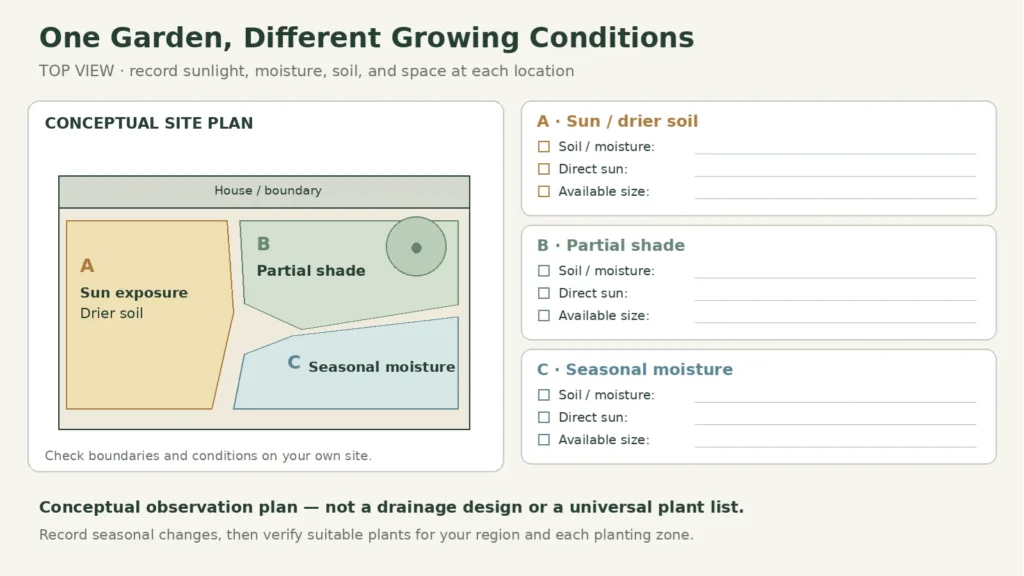
2. Record sunlight, soil, and moisture
Observe the area during the growing season at several times of day. Note direct sunlight, tree shade, building shade, reflected heat, and wind exposure.
Maryland Extension defines full sun in its native landscape guide as six or more hours of direct sunlight during the active growing season. It also notes that partial-sun and partial-shade terms are not strictly defined by one fixed duration. Use the chosen plant’s guidance alongside your observations. University of Maryland Extension
Build a site record
| Condition | What to observe | Why it affects selection |
|---|---|---|
| Light | Direct-sun periods and seasonal shade | Sun-loving and shade-adapted plants differ |
| Soil texture | Sandy, loamy, clay-rich, or mixed fill | Influences water movement and rooting |
| Moisture | Dry areas, ordinary moisture, persistent wetness | Separates plants with different tolerances |
| Soil chemistry | A suitable soil test, where useful | Helps identify pH and nutrient conditions |
| Exposure | Wind, reflected heat, road salt, or snow storage | May limit suitable choices |
| Space | Bed dimensions and nearby structures | Determines mature growth and access |
Do not assume “native” means tolerant of every soil. Match plants to the existing conditions where possible.
Use a local soil-testing service when the soil or its needs are unclear. Follow sampling instructions and recommendations rather than adding fertilizer or amendments automatically.
Distinguish a seasonally damp bed from a drainage problem affecting the house. A rain garden is a separate design task involving water movement, siting, and local guidance.
3. Check climate separately from native range
A hardiness zone is useful, but it does not establish whether a plant is native to your region.
The USDA map is based on average annual extreme minimum winter temperatures. It helps assess one aspect of cold tolerance; it does not describe your soil, drainage, summer heat, or sunlight. USDA Plant Hardiness Zone Map
For Canadian gardens, use appropriate Canadian regional guidance and check which hardiness system a plant label uses. Avoid assuming a zone number has the same meaning across every source.
Ask about planting season, winter conditions, summer moisture, and the specific location’s exposure. A plant beside a hot wall may experience different conditions from one in an open bed.
4. Build a short plant list with a purpose
Choose a few suitable species before adding more. Identify what each contributes: ground coverage, seasonal flowers, structure, or habitat for particular wildlife.
For pollinator planting, consider flowering through different parts of the growing season. Xerces recommends a mix of bloom times because different pollinators are active at different times. Xerces Society
| Candidate | Regional native status | Light/moisture match | Mature size | Bloom or garden role | Quantity |
|---|---|---|---|---|---|
| Plant A | ___ | ___ | ___ | Early-season interest | ___ |
| Plant B | ___ | ___ | ___ | Mid-season interest | ___ |
| Plant C | ___ | ___ | ___ | Late-season interest | ___ |
| Plant D | ___ | ___ | ___ | Structure or coverage | ___ |
Check mature spread, growth habit, and whether the plant readily seeds or spreads by underground stems. A vigorous regional native can still be difficult in a narrow bed.
Keep taller growth away from windows and routes where it would interfere with use. Consider winter appearance alongside flowers rather than treating bloom color as the only criterion.
5. Draw mature footprints and estimate quantities
Sketch the bed to scale and mark existing plants, pathways, and access areas. Draw new plants at their expected mature spread.
For a simple grid, use the selected spacing to test positions—not to establish one universal plant density.
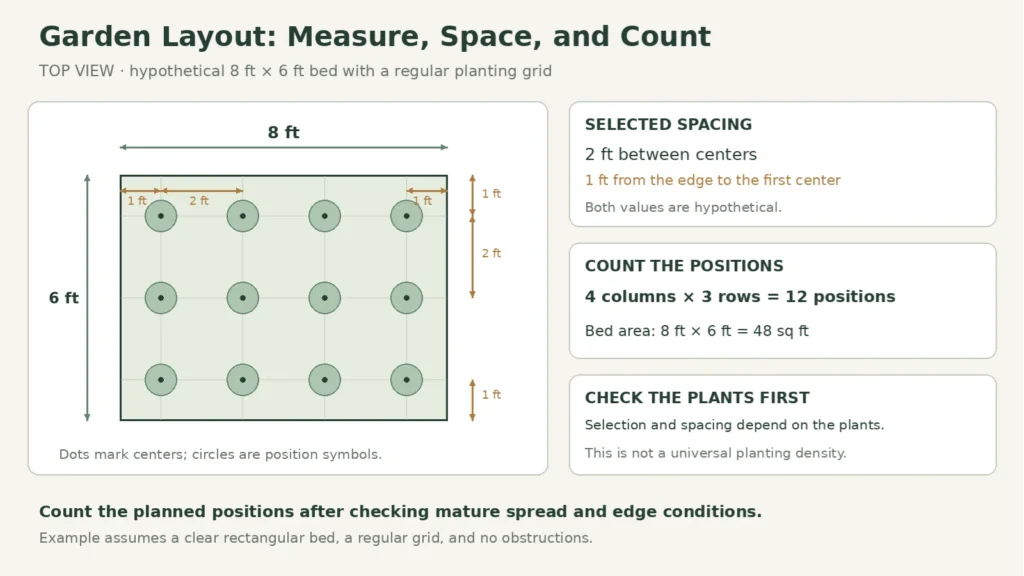
Example: a small rectangular planting
Assume a hypothetical bed measures 8 feet × 6 feet:
Bed area = 8 ft × 6 ft = 48 sq ft, approximately 4.46 m².
Suppose a suitable planting plan uses 2-foot center spacing and places the first centers 1 foot from each edge.
Along the length:
Columns = [(8 ft − 1 ft − 1 ft) ÷ 2 ft] + 1 = 4
Across the width:
Rows = [(6 ft − 1 ft − 1 ft) ÷ 2 ft] + 1 = 3
Plant positions = 4 × 3 = 12
This assumes a regular grid, no obstructions, and plants whose growth suits the selected spacing. It does not establish spacing for every native species.
For a mixed planting, draw each mature footprint and count positions by species. Review edges and access before ordering. MyProjectNest’s front yard planning guide provides related examples for plants, mulch, and project budgeting.
6. Choose plant sources and prepare the bed
Ask the supplier for scientific names, plant origin, and whether stock was nursery-propagated. Avoid collecting plants from the wild; use responsible sources, particularly for species with conservation concerns. CWF’s plant terminology explains its warnings for plants that may be wild-collected. cwf-fcf.org
If wildlife value is a main goal, ask about cultivar traits rather than assuming every selection provides the same benefit. Xerces notes that some highly altered flowers may offer little pollen or nectar or be less accessible to pollinators. Xerces Society
Identify existing weeds and choose a preparation method suitable for the site. Allow time for preparation before scheduling delivery. Avoid unnecessary disturbance near established tree roots.
Confirm quantities, establishment watering, and any suitable mulch or protection materials before buying.
7. Plant, monitor, and adjust
Follow instructions appropriate to the species and the nursery stock. Check planting depth, water needs, and local seasonal guidance rather than assuming every native plant uses the same method.
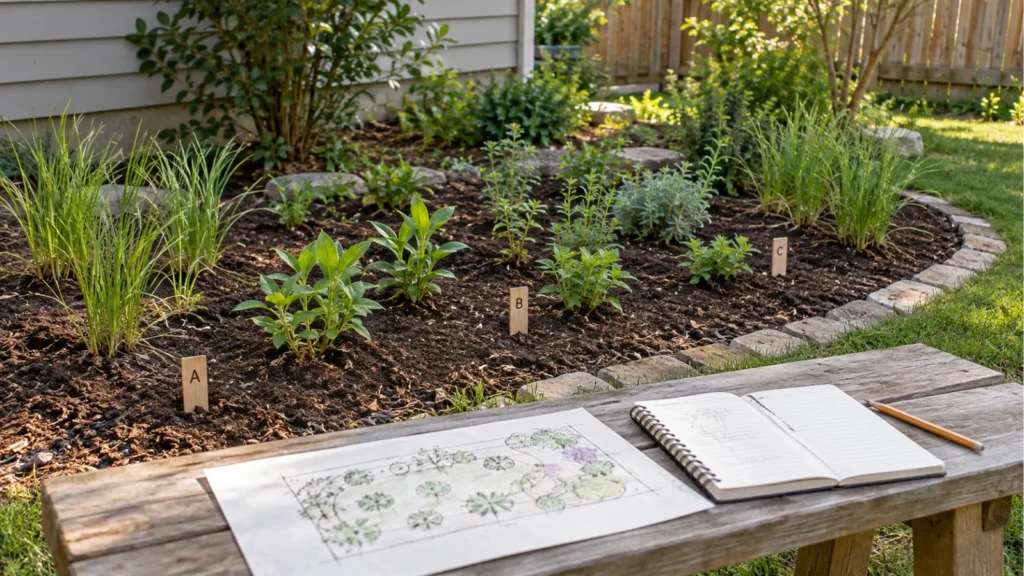
Place labeled plants on the prepared bed before digging. Recheck the arrangement against the sketch, then record where each species goes.
During establishment:
- Inspect soil moisture and water according to plant needs.
- Remove competing weeds while protecting the young plants.
- Keep labels or a planting map for identification.
- Watch for unexpected spreading or shading.
- Review growth through more than one season.
A native plant garden still needs care. Common mistakes include buying a national “native mix” without checking its species, assuming drought tolerance at planting, crowding small nursery plants, and replacing every existing plant at once.
Start with a phase you can maintain, then expand using what the site teaches you.