The most useful small front yard landscaping ideas improve one clear area while working with the site you already have. Keep healthy plants that fit, define a manageable planting bed, and choose new plants for the available light and their mature size. Estimate quantities before shopping.
A budget-friendly plan does not need to change the whole yard. Start with the view from the entrance or sidewalk, identify the biggest functional problem, and complete one section well. A coherent bed beside an existing walkway may be a better first project than scattered purchases across the lawn.
Resolve drainage, unsafe surfaces, and access problems before decorative planting. Plants and mulch cannot correct every site issue.
1. Prioritize the improvements that matter
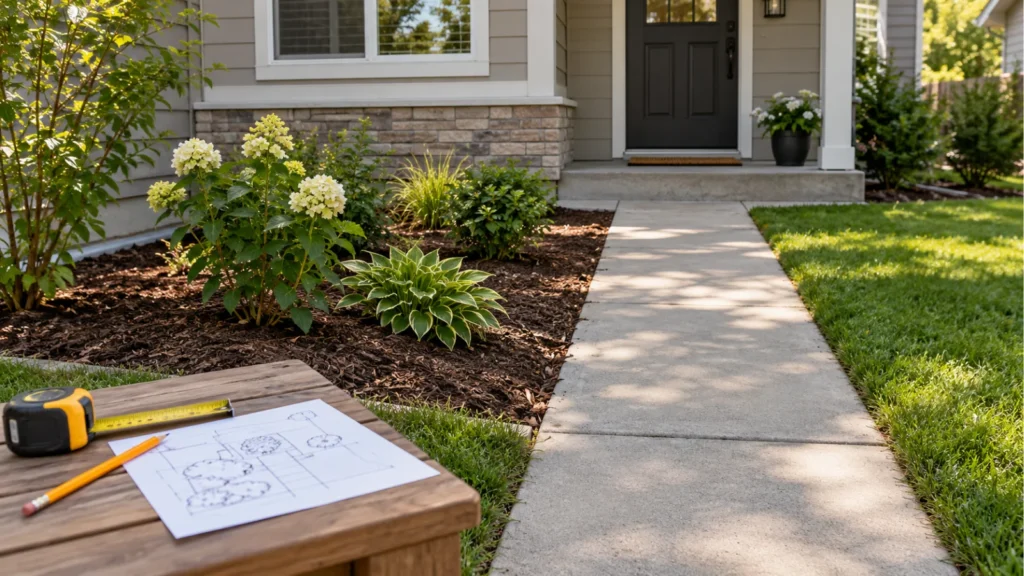
Walk through the yard before deciding what to buy. Is the problem an overgrown entrance, a difficult-to-maintain lawn corner, an undefined bed, or plants that no longer fit?
University of Maryland Extension recommends developing a landscape strategy with priorities that includes maintenance. Use that approach to separate necessary work from optional additions. University of Maryland Extension
| Priority | First question | Possible starting action |
|---|---|---|
| Access | Can people use the entrance comfortably? | Plan growth away from the route |
| Existing plants | Are they healthy and suitable? | Keep useful plants and assess problem ones |
| Bed definition | Is the intended planting area clear? | Mark a simple boundary |
| Site suitability | Do current plants fit the light and soil? | Choose replacements after observation |
| Appearance | What one area would benefit most? | Improve that area first |
Avoid adding decoration to a yard that already needs less clutter. Repeating a small number of suitable plant types can make the plan easier to understand and maintain.
2. Map the site and keep what works
Draw the house frontage, entry, driveway, walkway, existing beds, and trees. Measure the proposed work area rather than estimating from a photograph.
Observe direct sun at different times of day. Note damp spots after rain, dry areas beneath overhangs, and reflected heat from paving.
Keep downspouts, vents, meters, and service access clear. Do not pile soil or mulch against siding or change ground levels without understanding the effect on the building.
Assess existing plants before removing them. A healthy plant in the right location may contribute more than a new purchase. Mature trees need particular care; avoid treating their root area as an empty place for excavation.
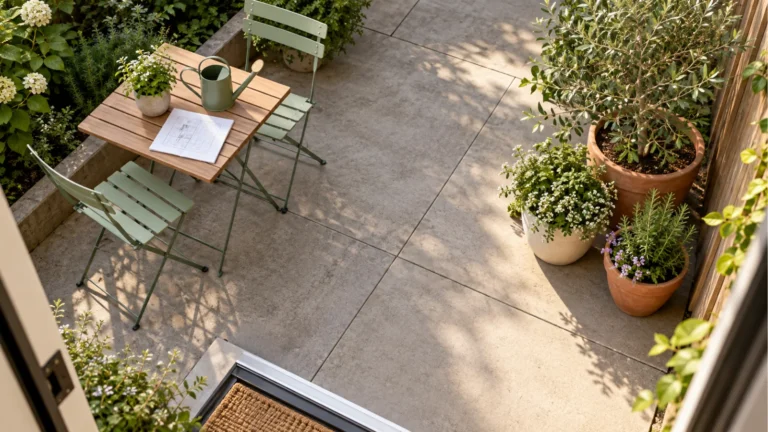
For a small change near the door, containers may be worth comparing with a new bed. MyProjectNest’s small patio garden guide explains how to plan containers around light, watering, and circulation.
3. Choose a simple planting layout
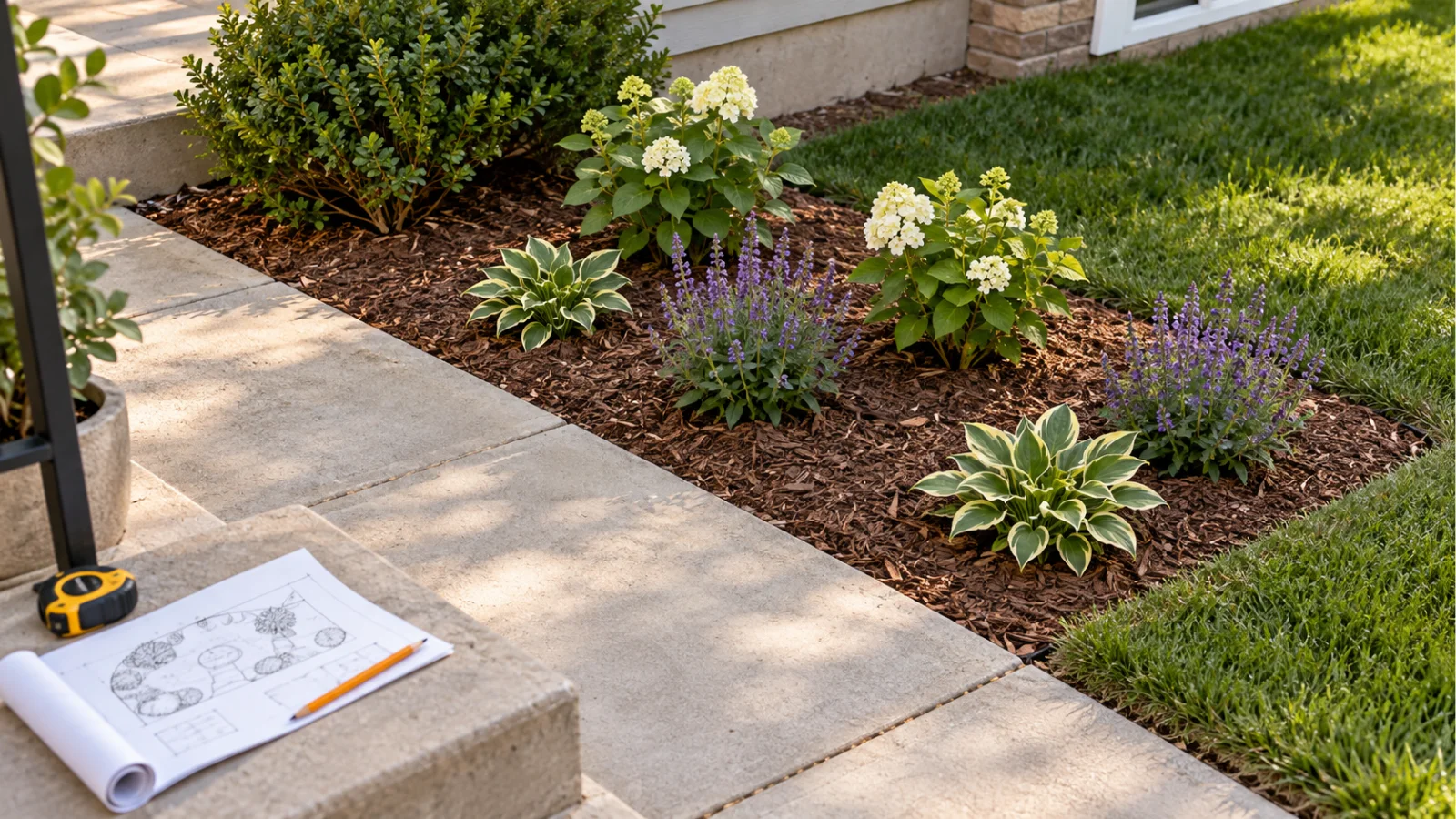
Start with a measured bed that is realistic to prepare and maintain. Use a hose to test its shape and view it from the entrance.
Keep the walkway visible and allow for mature plant spread. Place taller plants where they will not block windows, signs, lights, or sightlines.
| Plant role | What it contributes | What to check |
|---|---|---|
| Structural shrub | A longer-term framework | Mature height, spread, and location |
| Repeated perennial group | Seasonal interest and continuity | Light, spacing, and local suitability |
| Groundcover or low planting | Coverage near the bed edge | Spread, behavior, and maintenance |
| Container planting | A focused movable feature | Root space, drainage, and watering |
Check regional native plant guidance and local invasive-plant information. A plant recommended for Maryland is not automatically suitable for every U.S. state or Canadian province.
Maryland Extension’s native landscape designs emphasize that quantities depend on planting area, ultimate plant spread, and budget, and that projects can be installed in phases. Use regional examples as a planning method rather than copying their plant lists blindly. University of Maryland Extension
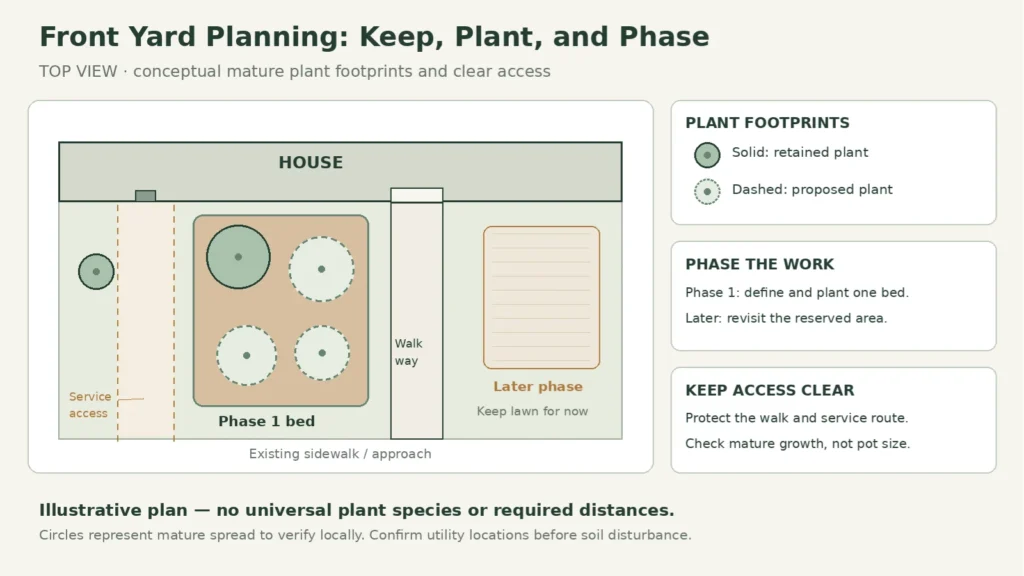
4. Estimate plant quantities from the layout
Measure spacing from plant center to plant center. Use the specific plant’s mature spread and recommended spacing, then mark each position on the sketch.
For a straight row with a chosen first and last center position:
Plant count = round down [(row length − two end offsets) ÷ center spacing] + 1
Assume a hypothetical 12-foot row has:
- First and last plant centers 1½ feet from each end.
- Selected center-to-center spacing of 3 feet.
Available center span = 12 ft − 1½ ft − 1½ ft = 9 ft
Plant count = 9 ft ÷ 3 ft + 1 = 4 plants
The centers fall at 1½, 4½, 7½, and 10½ feet along the row.
This example assumes identical plants in one straight row, with spacing and edge offsets selected for the intended mature growth. It is not a universal planting recommendation.
For mixed or staggered beds, draw each mature footprint and count the actual positions. Dividing total bed area by a generic “space per plant” can overlook edges, overlaps, and access.
5. Calculate mulch and edging before ordering
Measure the surface receiving mulch
For a rectangular bed:
Area = length × width
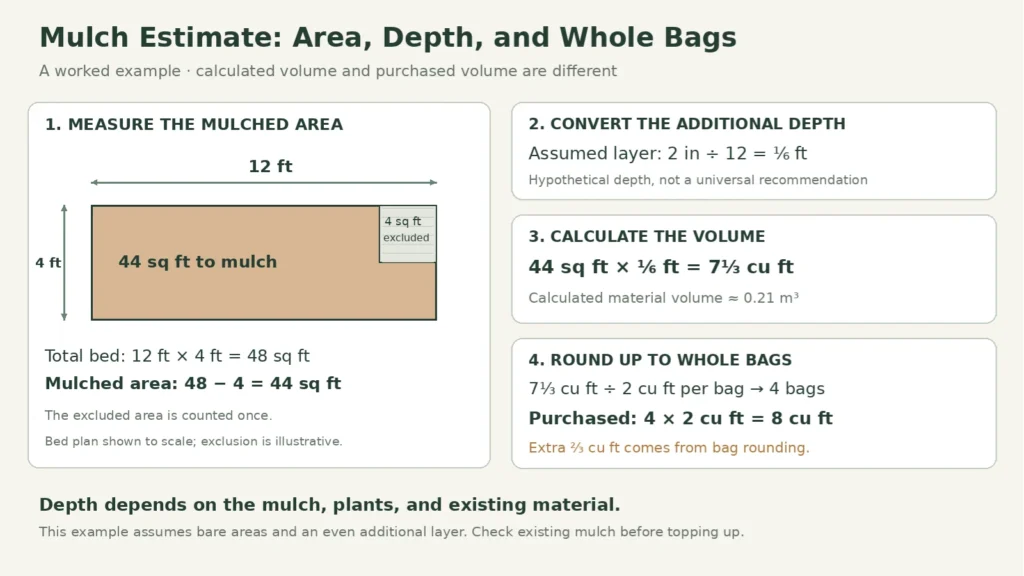
A 12-foot × 4-foot bed has:
12 ft × 4 ft = 48 sq ft
If the measured plan excludes 4 sq ft of non-mulched areas:
Mulched area = 48 sq ft − 4 sq ft = 44 sq ft
Count each exclusion once. Use nonoverlapping rectangles or another appropriate method for irregular beds.
Convert depth into volume
Mulch volume = mulched area × additional depth
Assume an illustrative 2-inch additional layer across bare areas:
Depth in feet = 2 in ÷ 12 = ⅙ ft
Volume = 44 sq ft × ⅙ ft = 7⅓ cu ft
That is approximately 0.21 m³.
For bags labeled 2 cu ft:
Bags = round up (7⅓ cu ft ÷ 2 cu ft per bag) = 4 bags
The purchased volume is 8 cu ft, about ⅔ cu ft more than the calculation. That extra comes from bag rounding, not an added waste percentage.
The example assumes an even layer over the measured area and no existing mulch contributing to the target depth. Check existing depth before topping up.
Mulch depth should suit the material and planting. Maryland Extension lists different depths for different mulches and warns against excessive accumulation; mulch should remain clear of tree trunks.
Measure only the edges you will finish
For the same rectangular bed, suppose edging goes along the two long sides and one short end:
Edging length = 12 ft + 12 ft + 4 ft = 28 linear ft
The fourth side is excluded by the plan. Compare that length with the product’s usable coverage, joining details, stake requirements, and cut plan. Do not assume nominal section length equals installed coverage.
6. Build a budget from quantities and local quotes
Separate material quantities from their prices. Obtain current local quotes in USD or CAD, then include tax, delivery, and any labor.
| Item | Planned quantity | Local unit quote | Extended cost |
|---|---|---|---|
| Plants by type | ___ | ___ | ___ |
| Mulch bags or bulk volume | ___ | ___ | ___ |
| Edging and required stakes | ___ | ___ | ___ |
| Preparation supplies | ___ | ___ | ___ |
| Watering supplies | ___ | ___ | ___ |
| Delivery, tax, and labor | — | — | ___ |
Project total = all extended material costs + delivery + tax + labor
Keep an unallocated amount if useful, chosen around the project’s uncertainty. There is no universal reserve percentage.
If the total exceeds your limit, reduce the first phase or postpone optional work. Do not compress plant spacing or skip necessary preparation to fit a larger shopping list.
7. Prepare and complete one phase
Arrange locating and approvals first, then mark the final bed and plant positions. Plan vegetation removal and soil preparation according to the existing site and reliable local guidance.
Position nursery plants before digging to check the arrangement. Follow plant-specific planting and establishment instructions, then apply appropriate mulch and set up watering access.
Review the yard as plants establish. New planting needs care even when the eventual design is intended to require less maintenance.
Common mistakes include buying without a mature-size plan, repeatedly adding mulch without measuring it, ordering edging for boundaries that will remain unfinished, and completing decorative work before addressing drainage.