The most useful small bathroom storage ideas give everyday items a home close to where you use them. Start with shallow wall storage, removable bins under the sink, and suitable door-mounted organizers. Keep only the items that need to stay at the basin on the counter.
Before buying anything, measure usable space around pipes, hinges, outlets, and moving doors. An organizer that fits inside a cabinet may still block a shutoff valve or prevent the door from closing.
You do not need to fill every available surface. Choose one crowded area, decide what belongs there, and test a storage solution that makes daily use and cleaning easier.
1. Plan storage around your daily routine
Make a short list of what repeatedly lands on the counter. Then give each group a nearby location.
| Group | Practical home | What to check |
|---|---|---|
| Daily skincare and grooming | Shallow cabinet or accessible bin | Tallest bottle and easy retrieval |
| Hair tools | Suitable cabinet compartment or holder | Cool-down instructions, cord space, access |
| Towels | Hooks, rail, or appropriate shelf | Hanging space and drying |
| Unopened toiletries | Labeled backup bin | Visibility and refill quantities |
| Cleaning supplies | Appropriate separate storage | Product labels and child access |
Keep one working supply of frequently used products accessible. Move unopened duplicates to a separate zone so they do not compete for the same small shelf.
A modest counter tray can define a home for soap or another basin essential. It should lift out easily for cleaning and leave room to use the faucet. Everything else needs a location you can reach without unpacking the bathroom.
2. Measure three storage zones
Record each zone separately rather than estimating from the bathroom’s overall size.
| Zone | Measurements to take | Obstructions to note |
|---|---|---|
| Wall | Available width, height, and projection | Mirror, lights, outlets, door swing |
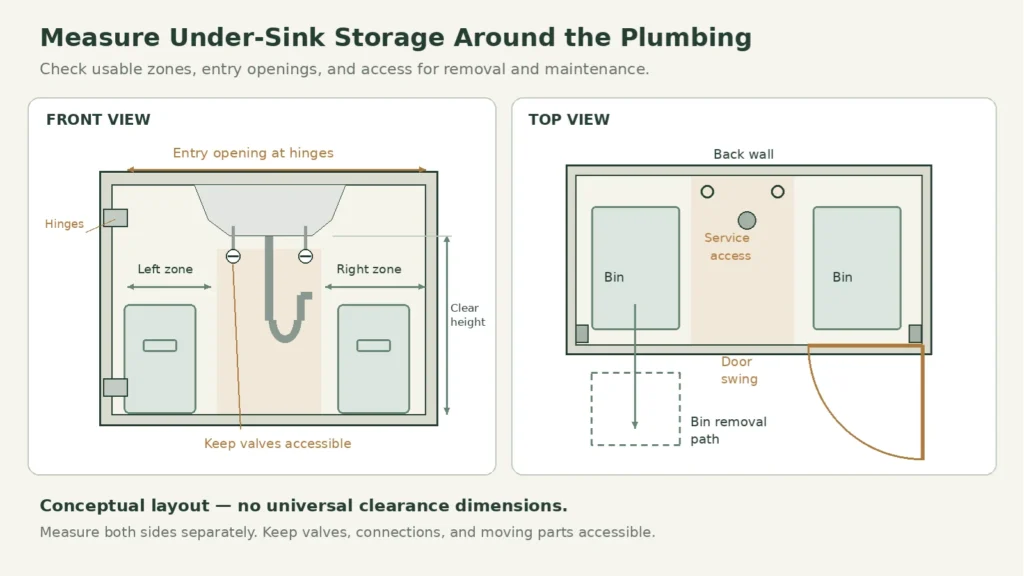
| Under the sink | Interior width, depth, height, and entry opening | Basin underside, trap, valves, hinges |
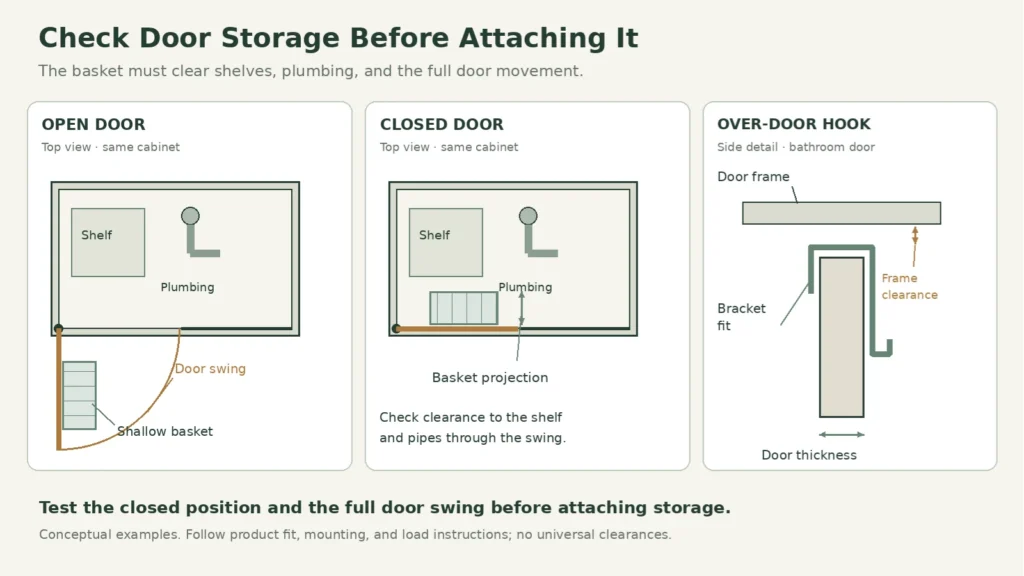
| Door | Usable area, thickness, and closed-position clearance | Frame, hinges, existing hooks, cabinet contents |
For wall storage, tape a cardboard mockup in the proposed position. Open nearby doors, use the sink, and move through the room. Check that the shelf or cabinet will not sit where someone could bump into it.
For cabinet storage, measure the largest usable spaces on either side of the plumbing. Treat the center as a service area that needs access, rather than assuming the entire cabinet is one rectangular storage box.
For doors, check both the organizer’s static position and its travel as the door opens.
3. Use shallow wall storage where it helps
Add a mirrored storage cabinet
A mirrored cabinet can move small bottles and grooming supplies off the counter. Compare its internal shelf dimensions with your products; outside width alone does not tell you whether a tall bottle fits.
Surface-mounted and recessed cabinets involve different work. KOHLER explains that surface-mounted cabinets attach to the wall, while recessed models sit between studs and require cutting into the wall and preparing the opening. Use the selected model’s specifications and instructions. KOHLER
Check the open-door position against nearby lights, walls, and faucets. Before drilling or cutting, investigate concealed plumbing and wiring. A recessed cabinet or a model with integrated electrical features may require professional work.
Choose a shelf or small wall cabinet
An open shelf suits a few frequently used items when they remain easy to see and retrieve. A closed cabinet can contain visual clutter, but its doors need opening space.
A shelf with a retaining edge may help keep small objects in place. Check usable depth inside that edge, not just the overall depth.
Match fixings to the wall and the manufacturer’s requirements. For example, IKEA’s TÄNNFORSEN wall cabinet requires secure wall attachment using fixing devices appropriate to the wall material; this is a product-specific requirement. IKEA
Give towels a drying location
Hooks can use a narrow wall section, while a rail provides room to spread a towel. Test the towel’s hanging length against the counter, toilet, floor, and adjacent hooks.
Plan for the towels actually in use. Avoid choosing a hook count that leaves several wet towels pressed into one small area.
4. Organize under the sink without blocking service access
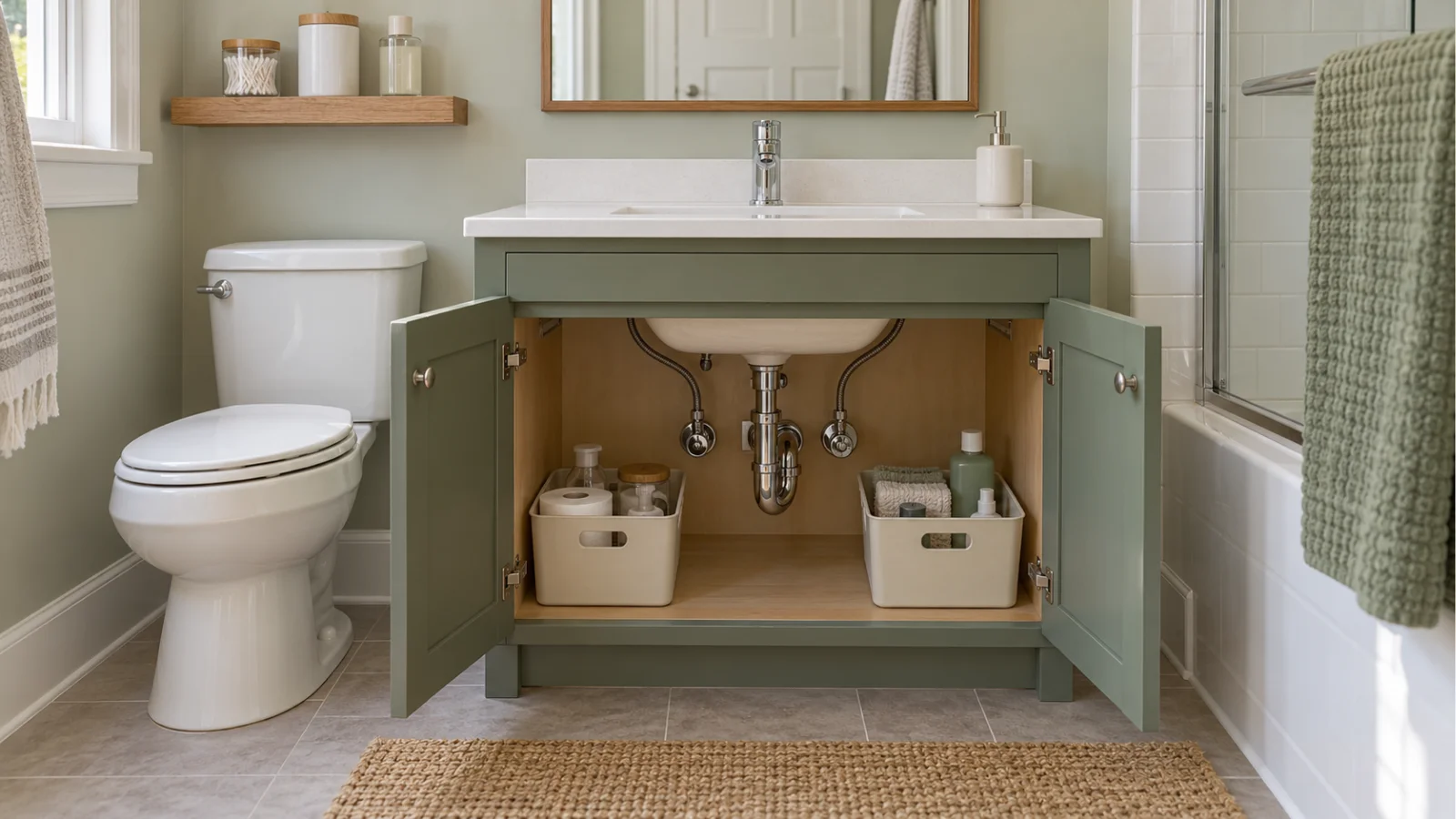
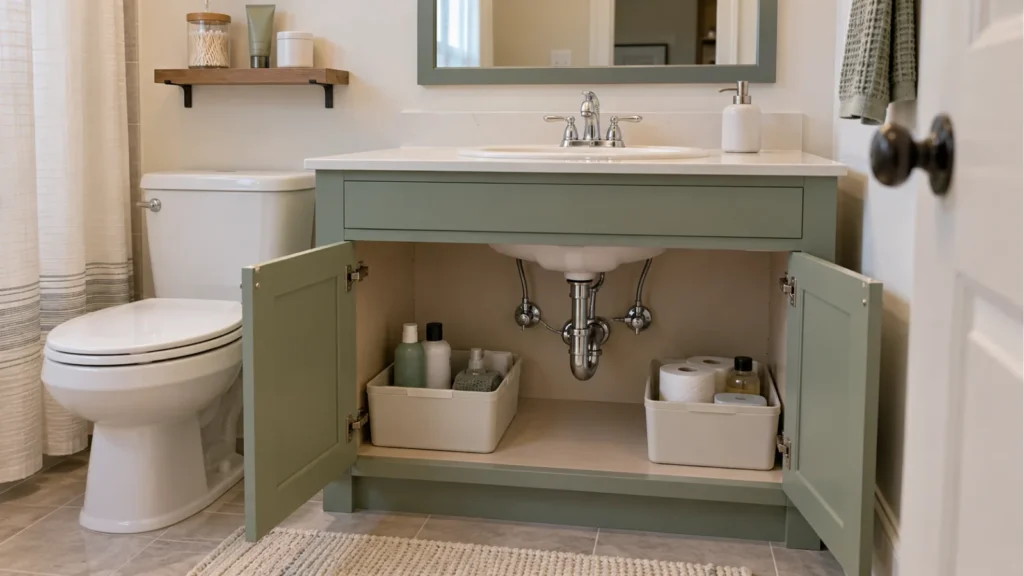
Two smaller removable bins often work better than one wide container beneath a sink. They can fit around the trap and make it easier to inspect the cabinet.
Group by task: one bin for spare toiletries, another for appropriate cleaning supplies. Keep products in their original labeled containers and store hazardous products according to their instructions, with suitable child protection where needed.
An adjustable shelf or pull-out organizer may help, but check its complete mounting and movement requirements. A sliding basket must clear the trap, hinges, and door opening throughout its travel.
Example: checking two bins beside a plumbing zone
Assume a hypothetical cabinet has 30 inches of clear interior width (76.2 cm). Your measured plan reserves 10 inches for the central plumbing and service-access zone.
Combined side-zone width = interior width − reserved center width
30 in − 10 in = 20 in
If the plumbing is centered, the two side zones are each 10 inches wide. Two proposed bins, each 9 inches wide, would leave:
Remaining width in each side zone = 10 in − 9 in = 1 in
That inch is unassigned space to evaluate during the fit test. It is not a required clearance.
This example assumes centered plumbing and equal side zones. Real cabinets may be asymmetrical. Measure both sides independently, then verify bin depth, height, handles, removal, and access to every valve and connection. The ten-inch center zone is illustrative, not a plumbing standard.
5. Put doors to work carefully
A lightweight organizer inside a vanity door can hold suitable small items. An over-the-door rack on the room door may provide towel or accessory storage when the door and frame are compatible.
Before choosing either, check:
- Door material and thickness.
- Hook or bracket fit.
- Clearance when fully closed.
- Interference with hinges, shelves, pipes, and stored bottles.
- Organizer and door load requirements.
- Whether mounting screws could pass through the door.
Use a cardboard profile to test the organizer’s projection. Close the door gently and move it through its full swing. A cabinet-door basket may need more clearance than the empty space directly behind it suggests.
Adhesive mounting requires product-specific checks
Use products approved for the surface and bathroom conditions. Command distinguishes its water-resistant Bath products from regular hooks and strips, and advises checking whether each product is shower-compatible. It also requires following the specific preparation, waiting time, and load instructions. Command™ Brand
Do not assume all adhesive products use the same cleaning method. Command’s bathroom instructions, for example, specify rubbing alcohol rather than household cleaners or water for the application steps shown. Follow the selected product’s guidance and confirm surface compatibility.
6. Choose materials and buy only the missing pieces
Compare bathroom suitability, cleaning instructions, mounting requirements, and loaded capacity alongside dimensions.
| Option | Useful when | Main tradeoff |
|---|---|---|
| Removable bins | You need flexible under-sink grouping | Must fit around plumbing |
| Open wall shelf | You want quick access to a few items | Contents remain exposed |
| Closed wall cabinet | You need contained storage | Requires support and door clearance |
| Door organizer | Wall or floor space is limited | Can interfere with closure |
| Narrow freestanding unit | A dry corner has usable floor space | Uses walking space; may require anchoring |
A finish described as moisture-resistant is not automatically suitable for direct shower spray. Confirm the intended location and care requirements.
Before ordering, list quantities, outside dimensions, mounting supplies, and any professional installation costs. Include delivery and accessories in the comparison rather than relying on the organizer’s purchase price alone.
7. Test the arrangement before adding more storage
Begin with removable storage and mockups. Install permanent pieces only after checking fit and access.
Return daily items first, then occasional supplies and backups. Check that you can clean the counter, remove each bin, reach plumbing connections, and open every door.
Common mistakes include placing deep shelves beside the sink at head height, filling the plumbing zone with fixed storage, hanging a rack that prevents door closure, and adding more containers before reducing duplicates.
For broader planning ideas, explore MyProjectNest’s Storage & Organization category.