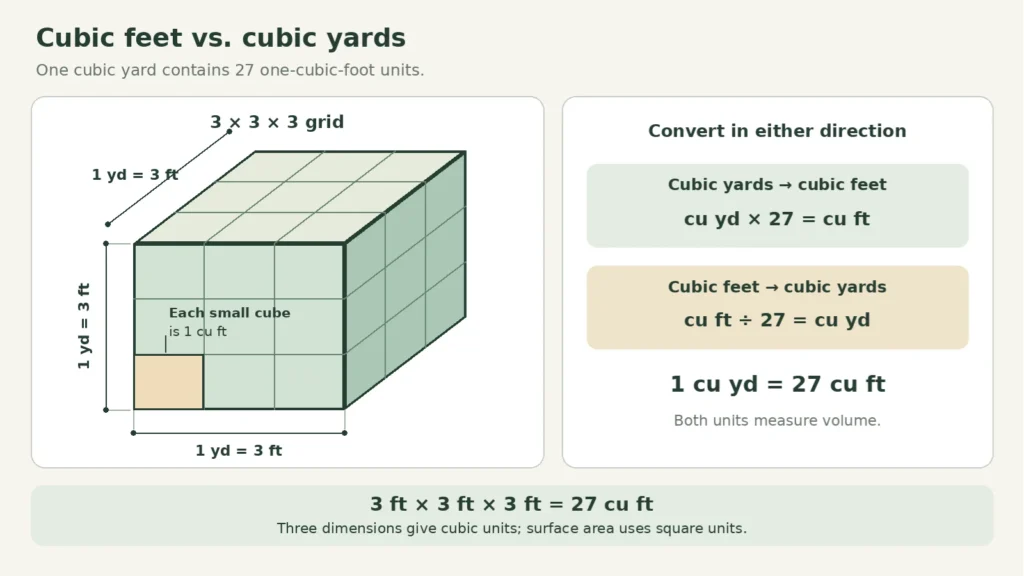
The difference between cubic feet and cubic yards is the size of the unit: 1 cubic yard equals 27 cubic feet. To convert cubic feet to cubic yards, divide by 27. To convert cubic yards to cubic feet, multiply by 27. NIST lists this relationship in its measurement tables. nist.gov
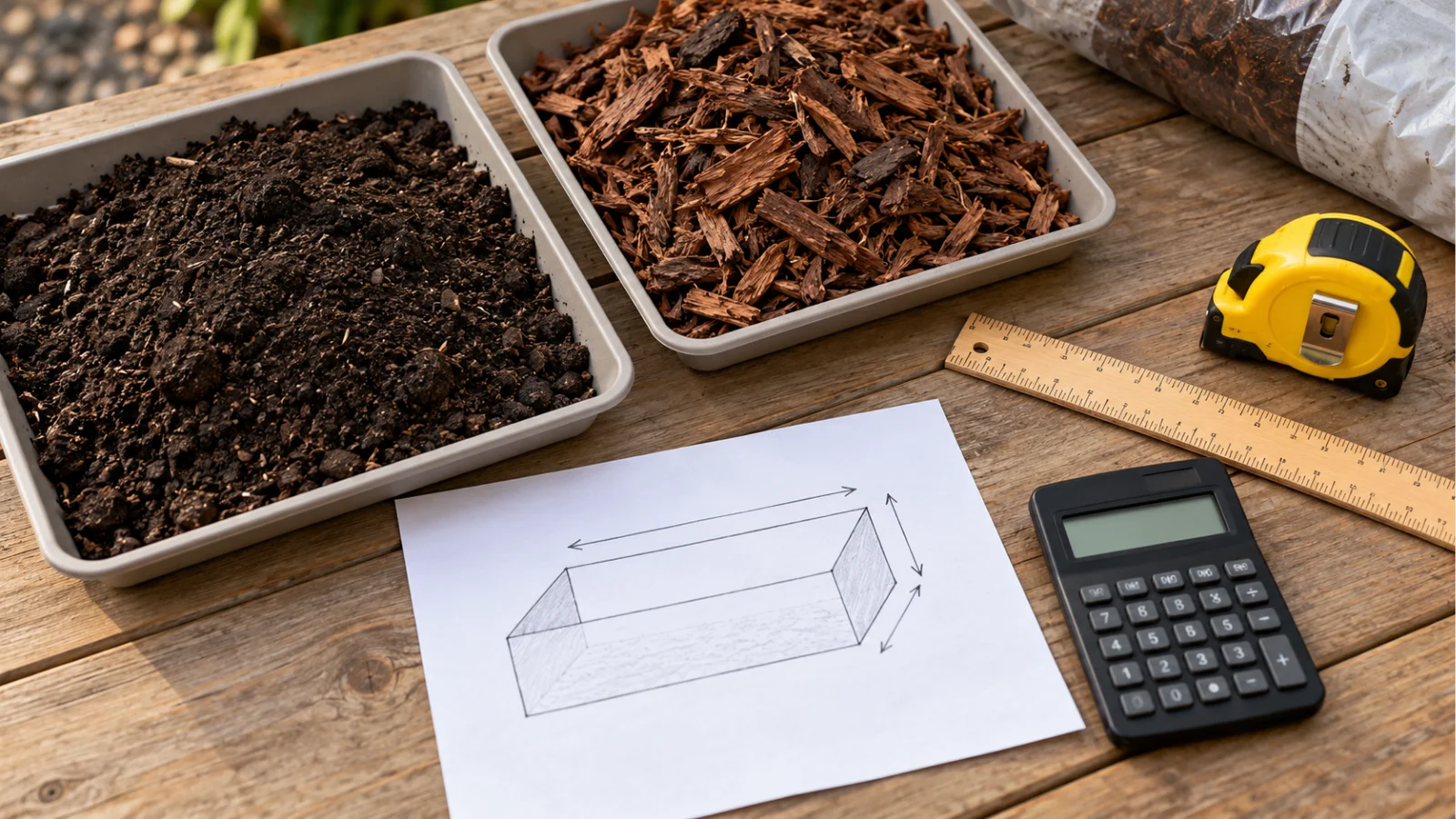
For a rectangular space, calculate material volume by multiplying length × width × depth, with all three dimensions in the same units. If length and width are in feet and depth is in inches, divide the depth by 12 first.
Translate the volume into whole bags or the supplier’s bulk increments. Keep calculated volume, justified allowances, and purchase rounding separate.
Understand length, area, and volume
A linear foot measures one dimension. A square foot measures a surface. A cubic foot measures three-dimensional space.
Imagine a cube measuring 1 foot in each direction. Its volume is 1 cubic foot. A cube measuring 1 yard in each direction is 3 feet × 3 feet × 3 feet:
3 ft × 3 ft × 3 ft = 27 cu ft = 1 cu yd
That is why dividing by 3 or 9 gives the wrong volume conversion.
| Measurement | What it describes | Example use |
|---|---|---|
| Linear feet | Length | Bed edging |
| Square feet | Area | Surface receiving mulch |
| Cubic feet or cubic yards | Volume | Mulch or soil quantity |
You cannot convert square feet directly to cubic yards without a depth. If you need help finding the footprint first, use the guide to calculating square footage.
Calculate cubic feet from area and depth
When depth is recorded in inches:
Volume (cu ft) = area (sq ft) × [depth (in) ÷ 12]
For a rectangle:
Volume (cu ft) = length (ft) × width (ft) × [depth (in) ÷ 12]
Worked example: a rectangular mulch bed
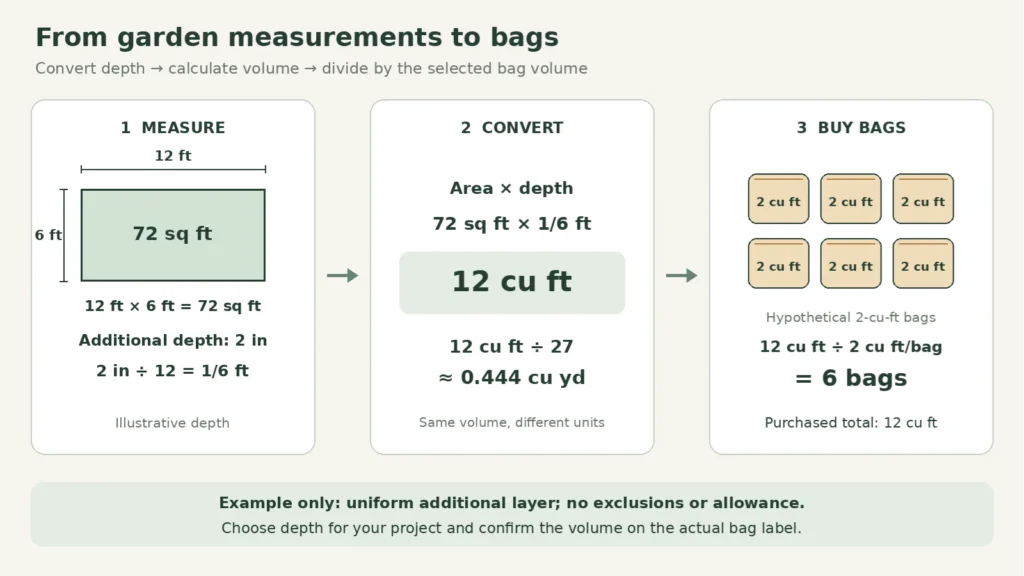
Assume a bed measures 12 feet × 6 feet, and the selected additional layer is 2 inches deep. The depth is illustrative, not a recommendation for every plant or mulch.
- Area: 12 ft × 6 ft = 72 sq ft.
- Depth: 2 in ÷ 12 = 1/6 ft.
- Volume: 72 sq ft × 1/6 ft = 12 cu ft.
- Convert: 12 cu ft ÷ 27 ≈ 0.444 cu yd.
This assumes a uniform layer across the full rectangle, with no excluded areas or added allowance. Keep the unrounded depth during calculation.
Account for exclusions and varying depths
Subtract surfaces that will not receive material, such as a stepping-stone area. Do not subtract an entire planted section if mulch will still cover the ground around its plants.
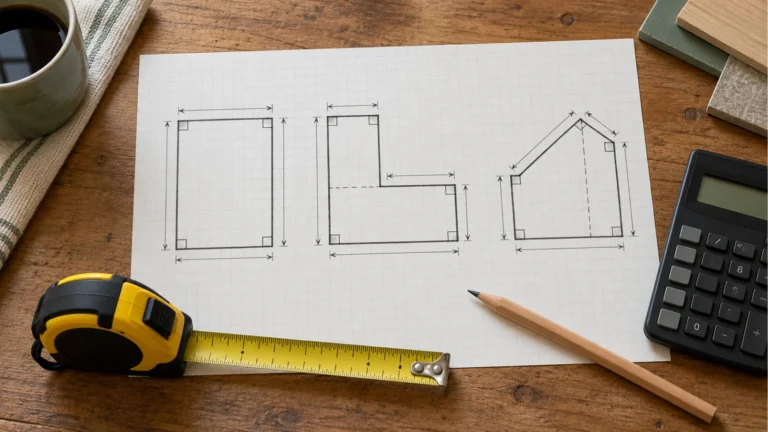
For an irregular bed, divide the footprint into nonoverlapping sections. If different sections need different depths, calculate their volumes separately and add them.
For example:
(40 sq ft × 2/12 ft) + (20 sq ft × 1/12 ft) = 8⅓ cu ft
This assumes each section has a uniform additional depth. Several depth checks are more useful than one measurement where the bed is uneven.
Measure the additional layer, not just the final depth
If existing mulch is suitable to retain, check its depth before calculating a top-up. University of Maryland Extension cautions against accumulating excessive mulch and advises replenishing it only as needed; mulch should also remain away from tree and shrub bark. University of Maryland Extension
A simplified top-up calculation is:
Additional depth = selected final depth − usable existing depth
If a project calls for a final 2-inch layer and an even, usable 1-inch layer remains, calculate the additional 1 inch. If the difference is zero or negative, no extra material is indicated by that depth calculation.
Patchy coverage, decomposed material, and a changed planting plan may require dividing the bed into smaller sections. For a broader garden refresh, see the small front yard planning guide.
Turn cubic feet into whole bags
Use the volume printed on the selected package:
Bags needed = required purchase volume ÷ volume per bag, rounded up to a whole bag
For the 12-cu-ft example, assuming hypothetical bags containing 2 cu ft each:
12 cu ft ÷ 2 cu ft/bag = 6 bags
If the calculated requirement were 13 cu ft:
13 cu ft ÷ 2 cu ft/bag = 6.5 bags → 7 bags
Those seven bags contain a declared total of 14 cu ft. The extra 1 cu ft comes from package rounding; it is not a separate waste allowance.
| Hypothetical bag volume | Bags for 12 cu ft | Declared purchased volume |
|---|---|---|
| 1 cu ft | 12 | 12 cu ft |
| 1.5 cu ft | 8 | 12 cu ft |
| 2 cu ft | 6 | 12 cu ft |
| 3 cu ft | 4 | 12 cu ft |
Check actual labels and availability before buying.
Convert to cubic yards for a bulk order
Cubic yards = cubic feet ÷ 27
Suppose several beds require 54 cu ft altogether:
54 cu ft ÷ 27 = 2 cu yd
For a requirement of 40 cu ft:
40 cu ft ÷ 27 ≈ 1.481 cu yd
If a hypothetical supplier sells in quarter-yard increments, the next available quantity is 1.5 cu yd, equivalent to 40.5 cu ft. Other suppliers may use different increments or minimum orders. Ask before rounding.
| Calculated volume | Equivalent cubic yards |
|---|---|
| 9 cu ft | ⅓ cu yd |
| 13.5 cu ft | ½ cu yd |
| 27 cu ft | 1 cu yd |
| 54 cu ft | 2 cu yd |
Compare bags and bulk using the same volume and material specification. Include delivery, handling, storage, and access in the comparison rather than assuming bulk is always cheaper.
Use inside dimensions for soil containers
For a rectangular raised bed, measure the internal space receiving soil. Outside frame dimensions include material that does not hold soil.
Assume inside dimensions of 8 feet × 4 feet and an additional fill depth of 9 inches:
8 ft × 4 ft × (9 in ÷ 12) = 24 cu ft
24 cu ft ÷ 27 ≈ 0.889 cu yd
This assumes vertical sides and uniform fill, before allowances or rounding. For tapered containers, account for the changing cross-section.
Ask the supplier how its soil is measured and what settling to expect. Keep any resulting adjustment explicit rather than automatically applying the same percentage used for flooring cuts.
Convert to liters or cubic meters when needed
For Canadian products labeled in liters, keep the estimate and package quantity in compatible units. Using international-foot conversions:
- 1 cu ft = 28.316846592 L.
- 1 cu yd = 0.764554857984 m³.
- 1 m³ = 1,000 L.
NIST provides these volume relationships. nist.gov
For the 12-cu-ft example:
12 × 28.316846592 ≈ 339.80 L
With hypothetical 40-L bags:
339.80 L ÷ 40 L/bag ≈ 8.495 → 9 bags
The declared purchased volume is 360 L. Use the unrounded conversion when possible, especially near a whole-bag boundary.
Match the volume calculation to the material
The geometry works for many materials, but the purchase basis changes.
| Material | What to confirm |
|---|---|
| Mulch | Additional depth, existing coverage, package volume |
| Soil or compost | Suitable blend, fill geometry, supplier guidance on settling |
| Gravel or sand | Loose versus compacted volume; density if sold by weight |
| Bagged concrete mix | Manufacturer’s mixed yield per bag |
For example, QUIKRETE’s Concrete Mix No. 1101 data sheet lists an approximate 0.60-cu-ft mixed yield for an 80-lb bag. That is a product-specific yield, not a conversion from pounds to cubic feet for every material. quikrete.com
For gravel bases or structural concrete, the required depth, compaction, and assembly need separate design decisions. A volume estimate alone does not establish installation requirements.
Check the order before buying
Use this short planning record:
| Entry | Your project |
|---|---|
| Material and intended use | ______ |
| Included area and exclusions | ______ sq ft |
| Additional depth | ______ in |
| Calculated volume | ______ cu ft / ______ cu yd |
| Documented adjustment and reason | ______ |
| Bag volume or bulk increment | ______ |
| Final purchase quantity | ______ |
Common mistakes include multiplying by inches without converting, dividing cubic feet by 9, counting overlapping sections twice, and adding both an allowance and package rounding without recording either.
Before delivery, identify a suitable unloading location and a clear route to the work area. Confirm the supplier’s access requirements and vehicle limits if collecting material yourself.